Health Investigation
The Headache Question Most Doctors in Singapore Overlook
In a 2022 study published in the journal Pain Medicine, most patients with cervicogenic headache had a physical source in the neck. It is the one place a brain scan never looks.
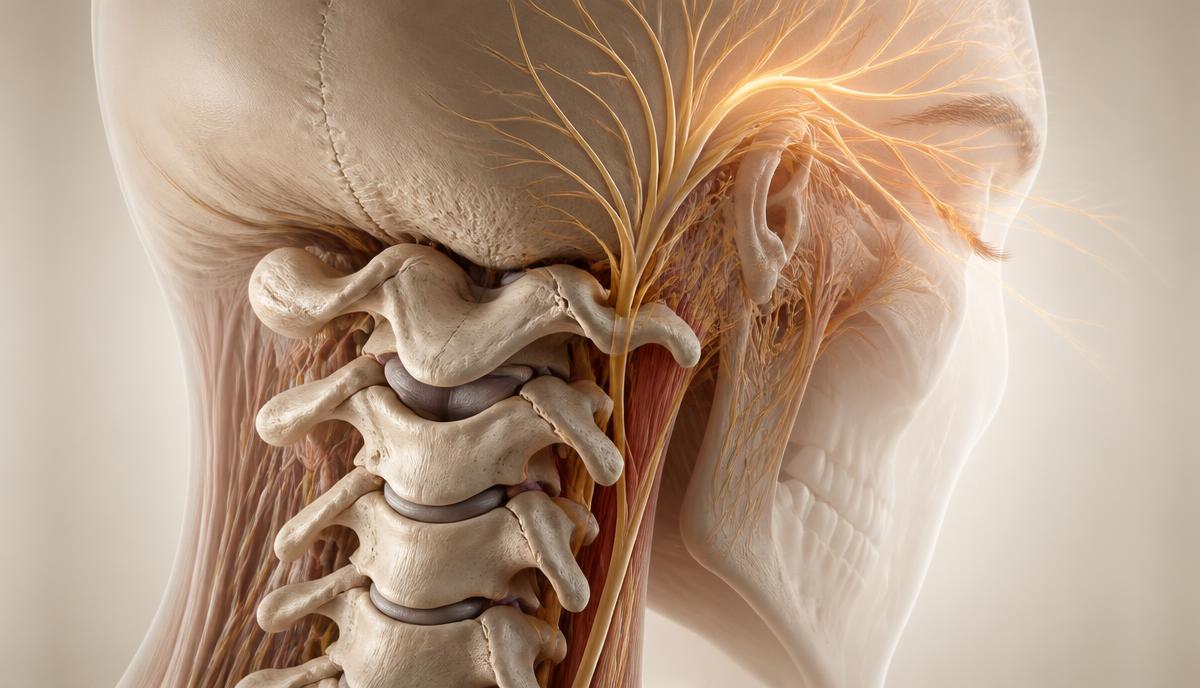
Take a story that plays out in headache clinics across Singapore every week. Call her Rachel.
She had been seeing doctors for her headaches since her late twenties. Over more than a decade she collected four different diagnoses: tension headaches, then migraine, then chronic migraine, then medication overuse headache. She tried a long list of medications. She sat through rounds of Botox and more MRI scans than she could count. She spent thousands of dollars and eventually stopped adding it up, because the number made her feel worse.
She had done everything a sensible person does when something is wrong. Made the appointments. Taken the referrals. Followed the instructions.
The headaches never went away.
And the line that sums up her whole experience is one many headache sufferers will recognise:
"Every doctor I saw was excellent at explaining what was happening in my head. Nobody ever asked about my neck."
That gap is what this article is about.
The Question That Rarely Gets Asked
Walk into a headache consultation at most Singapore clinics and you will be asked about family history, sleep, stress, caffeine, screen time, and cycle patterns. You will have a neurological assessment. Probably imaging.
What you almost certainly will not get is a structural assessment of your cervical spine.
That matters because of a controlled diagnostic study published in Pain Medicine in 2022. Researchers tracked 166 patients with cervicogenic headache and used precise diagnostic blocks to pinpoint the physical origin of each person's pain.
In the patients whose headache was the dominant complaint, they established a structural source in the neck in 75 percent of cases. The C2-C3 joint, a specific structure at the top of the neck, was responsible in 62 percent of them.
That is not a marginal finding. Among this group, the majority of headaches carried a physical, structural cause in the neck. Not in the brain. Not in stress hormones. Not in whatever the current diagnostic label happened to be.
Most people never learn this. Often, neither do the practitioners they see, until someone finally orders a cervical X-ray.
Could your headache actually start in your neck?
If you have had chronic headaches and no one has ever taken a structural X-ray of your neck, that is the question worth answering.
$168 Headache & Cervical Assessment includes:
- Structural X-ray of the cervical spine
- One-to-one consultation with Dr Will Kalla
- Trial correction session
Leave your details and the clinic will get in touch.
Why Headache Pain Feels Like It Is Coming From Your Head
The reason cervicogenic headaches get misread so reliably comes down to a piece of anatomy most people have never heard of.
The trigeminal nerve covers the face, the temples, and most of what people experience as head pain. The upper cervical nerves, C1, C2, and C3, run through the top of the neck. These two systems converge in the same region of the brainstem.
In practice, that means irritation at C2-C3 does not necessarily feel like neck pain. It can feel like pressure behind the eyes, a band tightening across the forehead, or a stab at the temple. Because the signals travel shared pathways, the brain often cannot tell a neck source from a head source. It reads a neck problem as head pain.
This is not a fringe idea. The referral pathway from the upper cervical structures to the back of the head, temples, and eyes is documented anatomy, referenced across the headache literature. Turning that anatomy into a question at a headache consultation simply happens less often than the evidence suggests it should.
The Difference Between Treating Smoke and Finding the Fire
Most headache treatments do something. That is what makes the cycle so frustrating.
Massage
Helps, for a day or two. It releases the muscle tension built up around irritated cervical joints. Then the same underlying problem produces the same guarding and the same pain returns.
Medication
Helps, until the dose needs increasing, or the pain rebounds harder, or the side effects become their own problem.
Botox
Helps, by dampening pain transmission. The structural pressure generating those signals keeps pressing regardless.
Generic adjustments
Adjustments that do not target overall alignment help, temporarily, for the same reason massage does. They act on the output, not the source.
None of these are wrong. Temporary relief is still relief. But they clear the smoke while the fire keeps burning.
In the majority of cervicogenic cases, that fire is mechanical misalignment at C2-C3, which is measurable, visible on X-ray, and structurally correctable.
A 2025 network meta-analysis in Frontiers in Neurology compared manual-therapy interventions across 1,297 patients with cervicogenic headache. Ranked by probability of being the most effective for pain reduction:
Probability of ranking first for pain reduction
The pattern reflects the difference in target: one addresses the structure, the others address its downstream effects.
What Singapore's Working Hours Do to C2-C3
Singapore has one of the highest sustained screen-work rates in the world. Forward head posture, the position most desk workers settle into after hours at a CBD dual-monitor setup, loads the upper cervical spine.
At neutral posture the head weighs about 5kg. Tilt it forward toward a screen and the effective load on the neck climbs steeply, to roughly 22kg at 45 degrees. C2-C3 absorbs a disproportionate share of that, day after day, year after year.
Over time the joint wears, alignment shifts, and the greater occipital nerve, which runs through this region on its way to the scalp, starts receiving mechanical irritation the brain reads as headache.
The 3pm headache that arrives reliably after a full day of screens. The tension that builds at the base of the skull before it spreads forward. These are not random stress responses. They are mechanical signals with a specific structural source.
What a Cervical X-Ray Can Reveal
For someone with a history like the one above, a structural X-ray is often the first time the whole picture makes sense.
It measures the cervical curve in degrees. A healthy neck holds a gentle forward curve. Years of screen posture can flatten it, or reverse it into what clinicians call a military neck. On the film, misalignment at C2-C3 shows up clearly, and with it, a plausible explanation for years of treatment aimed at the wrong place.
This is what Dr Will Kalla does at Dr Neck Pain's Bugis clinic. Every case starts with a measured X-ray, not a guess. He reads the film with the patient, shows them the exact angle of their curve, and explains whether the structure is likely contributing to their headaches. Where it is, the goal of the R3NEW X™ correction program is to restore the curve itself, confirmed on a second X-ray at the end, rather than to keep managing the symptom.
Dr Kalla has worked with over 3,000 patients across 38 countries, and every case is measured on film before and after.
Who This Is For, and Who It Is Not
Dr Will Kalla is specific about patient selection. Not every headache has a cervical source.
"If someone's X-ray shows no meaningful structural contribution, I tell them that at the assessment. I would rather do that than put someone through a program that is not designed for their situation."
Patients most likely to have a structural component are those whose headaches:
- Start at the base of the skull and radiate forward
- Worsen consistently after sustained desk work
- Respond briefly to neck massage or manipulation but always return
- Come with neck stiffness or tension that builds in the upper neck before an attack
- Have shown only partial, diminishing response to treatments like triptans, Botox, or CGRP inhibitors
The assessment determines candidacy honestly, before any program commitment.
For patients where a full 90-day correction program makes sense, the 36-session package carries a money-back guarantee: if cervical alignment has not significantly improved at the 90-day X-ray, the treatment fee is refunded.
The clinic is a five-minute walk from Bugis MRT and City Hall MRT. Lunchtime and after-work slots are reserved for CBD professionals.
The Question Worth Getting Answered
Rachel's reflection is the one worth borrowing. She wished someone had simply asked about her neck and taken an X-ray, instead of spending years treating a problem in the wrong place.
So the question most headache consultations never ask is the one to ask yourself: is the structural source of your pain in your cervical spine?
Finding out takes one appointment.
The entry-point appointment covers three things: